
I can’t believe that summer is almost over. How can that be possible? With the crazy weather we’ve had this year, it seems as though our summer was given to us in short spurts, and people are scrambling to enjoy what’s left of it. Everyone seems to be making end-of-summer getaway plans, throwing impromptu barbecues, and packing in those picnics that didn’t happen earlier in the season.
So what do you bring for the stop-over during the car ride? What can you easily make to bring to that last-minute barbecue or picnic? Pasta salad is always a good choice. It’s easy to make and people love it.
There are so many ways to make pasta salad, so many ingredients to choose from. And so many dressing you can use. This time around, why not use green goddess dressing?
Green goddess dressing, as you might imagine, is so name because of the green ingredients, chopped up finely and sparkling like gems throughout the dressing. It’s traditionally made with mayonnaise, sour cream, chives, tarragon, parsley, lemon juice, anchovies, and, depending on who you ask, chervil. Many people have taken to using avocado in their green goddess, which enhances its green color and lends it a buttery creaminess. I’m all for that.
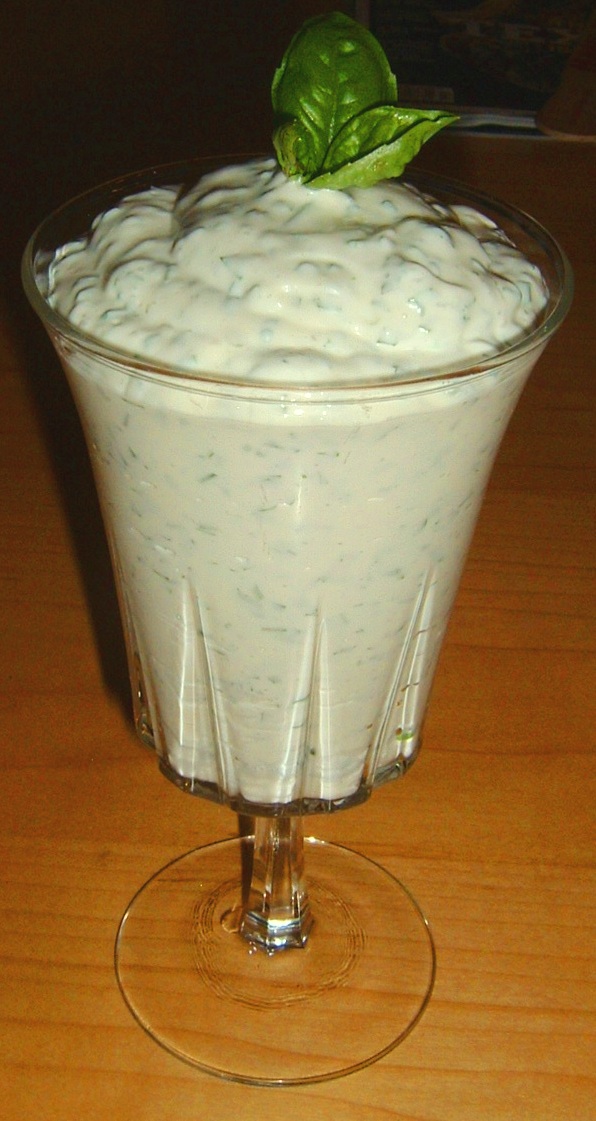
My Green Goddess Dressing
The creation of green goddess dressing is attributed to the Palace Hotel, built in 1875, in San Francisco. Now known as the Sheraton-Palace, it is considered San Francisco’s first “grand” hotel. As the story goes, in 1923, actor George Arliss was in the City by the Bay to star in a play called The Green Goddess, by writer/critic William Archer. Arliss starred in the 1923 silent film adaptation of the play, also called The Green Goddess. Then it was remade in 1930—Arliss reprised his role—and was one of the first “talkie” films ever made. The 1923 version is only one of three of Arliss’ silent films that are known to have survived.
Meanwhile, back at the ranch…
The executive chef at the Palace, Philippe Roemer, wanted to make something special for the banquet that was being prepared in honor of Arliss, so he created the green goddess dressing. It’s actually a variation of an already established dressing created by a chef of the Court of King Louis XIII of France in the 17th century. The sauce was indeed green, hence its name—au vert—but was served with seafood, particularly eel. There’s even a recipe for it in the iconic epicurean tome Larousse Gastronomique, by Prosper Montagne, first published in 1938.
In the 1970s, Seven Seas (now part of the Kraft company) came out with a bottled version of green goddess, and Annie’s Naturals has a vegetarian version (i.e., no anchovies). It’s still a popular dressing on the West Coast.
Below is my (anchovy-less) recipe for Green Goddess Dressing. Because fresh tarragon may be hard to find if you’re not close to a really good market or not, say, living in Provence, I make mine with basil. (On that note, tarragon is one of those herbs that are worth growing yourself.)
This is what I mean whenever I say that food is steeped in history (which I say often in my cookbook, What, No Meat? Traditional Italian Cooking the Vegetarian Way). It’s closely intertwined with politics, folklore, culture, social mores, war, economics, psychology, geography, and superstitions. What we eat did not just land on our plates one day. It took a journey—sometimes a short, uneventful one, sometimes a long, complex one. This is the stuff I share in my book. It’s really amazing what we take for granted.
Next time you have a salad with green goddess dressing, remember what a grand debut in the world it had. Cherish it. Praise it. Kiss it. Okay, don’t do that. Just appreciate the food you have and how lucky you are to have it. Not everyone in the world is that lucky.
Have a great week, and may Mother Nature take pity on us and give us a good rest of the summer.
Roberta’s Green Goddess Dressing
1 cup mayonnaise
1/2 cup sour cream
1/4 cup minced chives
1/4 cup minced parsley
2 tbsp minced basil
1 tbsp fresh lemon juice
1 tbsp white wine vinegar
Kosher or sea salt to taste
White pepper to taste (preferably freshly ground)
Whisk together all ingredients until well blended. Refrigerate until needed. If it’s too thick, thin it out with a little water or canola oil.



 Miz Chef