
Hi, all. I’ve been on a bit of hiatus the past several weeks because…well, life. But I’m jumping back in with a new project.
Several years ago, I purchased a massive book called La Cucina—The Regional Cooking of Italy by Accademia Italiana della Cucina (The Italian Academy of Cuisine), published by Rizzoli Publications. It’s a compendium of thousands of recipes from the 20 regions of Italy.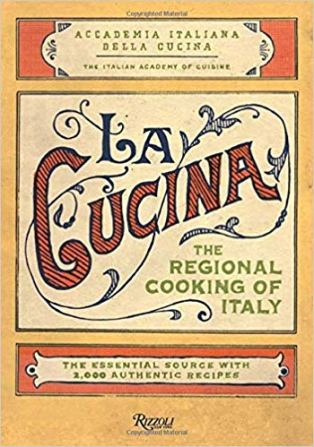
I had this idea to work my way through this book—figuratively through Italy—but it’s an impractical goal. In the first place, many of the recipes call for regional or Italy-specific products that would be impossible to get here, even with the internet.
Second, many recipes hinge on the inclusion of products that I simply wouldn’t use, whether I can get them or not. I will not cook, for example, organ meats. And since I keep my meat intake in general to a minimum, many of these dishes would be just too much.
Third, it would take me years to make all of them.
So, I took a practical, reasonable, and (for me) enjoyable approach to this little venture. I decided to choose four recipes from each region. I based my decisions not just on dishes that I thought I would enjoy eating, but those that seemed different in some way from my everyday fare, those that sounded intriguing in some way, or those that take a different approach to a familiar dish.
Although I can’t share the recipes with you word for word (because that would be copyright infringement), since these are traditional regional recipes, I can share the ingredients with you and some basic preparation instructions, according to what I believe they should be. And I say that because…
As I started working with the recipes, I began to see a problem, which is that the instructions are, here and there, somewhat vague. I wasn’t always sure how long I should cook something, or what result I was supposed to be looking for. For example, one recipe says to heat olive oil in a pan and to sauté pancetta and onion, but it doesn’t say to what point. Is the onion just supposed to soften and get translucent? Is it supposed to get lightly brown? Deeply brown?
So I realized that I had to just use my instincts on some of these recipes, and I will share will you what I feel are the most suitable preparations.
The 20 regions represented in the book are Abruzzo, Basilicata, Calabria, Campania, Emilia-Romagna, Fruili-Venezia Guilia, Lazio, Liguria, Lombardia, Marche, Molise, Puglia, Sardegna, Sicilia, Toscana, Trentino-Alto Adige, Umbria, Valle d’Aosta, Veneto.
I’m going to go through the regions alphabetically, starting with Abruzzo. However, another thing I realized is that I was going to have to make some of these recipes out of order based on the seasonality of the ingredients required. So, later on, while I’m in the middle of alphabet, perhaps in Lombardia or Molise, a recipe from Basilicata might come up. Or perhaps while I’m in the midst of doing Toscana or Umbria, recipes from Lazio or Puglia might surface.
This is a project I’m doing for fun and to indulge my love and passion for Italian food, so I’m not holding myself to any hard-and-fast rules. My only goal here is to capture the essence of each recipe, sample these regional foods, and maybe introduce you, dear readers, to the cuisines of Italy.
I hope you try these recipes, too, and keep the traditional foods of the Old World alive.
 Miz Chef